Quick start
Install cg, index a sample, ask four questions, and connect an agent. Python 3.11+.
Install
pipx install cg-code-graph
# or: uv tool install cg-code-graph
cg doctor
cg doctor shows which languages index exact or heuristic on this machine. Other options: Install.
Index a sample
The Django sample needs nothing but Python.
git clone https://github.com/cyberchronos00/code-graph.git && cd code-graph
cg index examples/bookstore-django --name bookstore-django --db out/api.db
Stdout is stats JSON (nodes/edges, plus starters: queries that resolve in this graph). Stderr ends with coverage. out/ is created for you. For your own repo: cg index . --db out/graph.db.
coverage: python 32 exact
  frameworks: django, django-ninja, djangorestframework | presets: common, python, django, django-ninja, djangorestframework | config: no .cg.yaml
Ask questions
What reaches a table
cg reaches table:store_books --db out/api.db
targets: table:store_books -> 1 node(s): table:store_books
dependents: 18 nodes  (code: 6, entry points: 9, other: 3)
== RUNTIME (reached from http_route / ... / queue_job / listener): 5 functions/methods
    catalog.api.create_book  depth=1 conf=resolved  http_route(1)
        path: function:catalog.api.create_book
          -WRITES_TABLE[resolved @ catalog/api.py:27]-> table:store_books
    catalog.signals.review_saved  depth=3 conf=resolved  listener(1)
        path: function:catalog.signals.review_saved
          -DISPATCHES[exact @ catalog/signals.py:12]-> job:catalog.tasks.recompute_rating
          -HANDLED_BY[exact @ catalog/tasks.py:13]-> function:catalog.tasks.recompute_rating
          -READS_TABLE[resolved @ catalog/tasks.py:14]-> table:store_books
Who writes it
cg writers store_books --db out/api.db
[catalog] catalog.admin.BookAdmin  WRITES_TABLE table:store_books  @catalog/admin.py:6 (resolved)  entries: admin_panel
[catalog] catalog.api.create_book  WRITES_TABLE table:store_books  @catalog/api.py:27 (resolved)  entries: http_route
[catalog/management/commands] catalog.management.commands.import_books.Command.handle  WRITES_TABLE table:store_books  @catalog/management/commands/import_books.py:18 (resolved)  entries: management_command
...
7 write edges, 4 writers
Unguarded routes that write
cg routes --writes --unguarded --db out/api.db
routes reaching a write (any table): 2 of 19 routes | filter: no auth guard -> 1
POST /api/books/  @catalog/api.py:25  NO AUTH
    guards: (none)
    writes store_books via catalog.api.create_book conf=resolved  ROUTES_TO@api.py:25 → WRITES_TABLE@api.py:27~r → table:store_books
Impact of a change, and its source
cg impact catalog.api.create_book --db out/api.db then cg snippet catalog.api.create_book --db out/api.db
callers (transitive): 0
entry points: 1
  http_route       POST /api/books/  conf=exact
        path: route:POST /api/books/
          -ROUTES_TO[exact @ catalog/api.py:25]-> function:catalog.api.create_book
catalog/api.py:26-28
26| def create_book(request, payload: BookIn):
27|     book = Book.objects.create(**payload.dict())
28|     return 201, book
Every edge carries exact, resolved or heuristic. --min-confidence resolved hides guesses. See CLI reference and Query targets (specs).
Tests a change affects
cg affected catalog/api.py --db out/api.db on that index (cg index examples/bookstore-django --name bookstore-django --db out/api.db):
changed: 1 file, 12 symbols
M catalog/api.py  12 symbols

tests: 3 (3 direct, 0 transitive, 0 UI, 0 changed) in 1 file
catalog/tests/test_api.py
  test_list_books [pytest] :7  direct  via route:GET /api/books/
  test_book_endpoints [pytest] :13  direct  via route:GET /api/books/{book_id}/
  test_order_needs_token [pytest] :18  direct  via route:POST /api/orders/

entry points: 6
  http_route  GET /api/books/  (catalog/api.py:15)  via route:GET /api/books/
  http_route  GET /api/books/{book_id}/  (catalog/api.py:20)  via route:GET /api/books/{book_id}/
  http_route  GET /api/books/{book_id}/availability/  (catalog/api.py:31)  via route:GET /api/books/{book_id}/availability/
  http_route  GET /api/orders/{order_id}/  (catalog/api.py:49)  via route:GET /api/orders/{order_id}/
  http_route  POST /api/books/  (catalog/api.py:25)  via route:POST /api/books/
  http_route  POST /api/orders/  (catalog/api.py:37)  via route:POST /api/orders/
--base main keeps only the affected lines. --quiet prints the test files. See CLI reference.
Link a frontend and a backend
Flutter app plus Django API. Needs the Dart SDK; cg doctor shows dart exact.
cg index examples/bookstore-flutter --name bookstore-flutter --db out/app.db
cg link --backend out/api.db --frontend out/app.db \
        --backend-name bookstore-django --frontend-name bookstore-flutter --db out/graph.db
cg routes --db out/graph.db
Link stats: "client": "bookstore-flutter", "server": "bookstore-django", "endpoints": 7, "endpoints_matched": 6.
GET /api/books/  @bookstore-django/catalog/api.py:15  NO AUTH
    guards: (none)
    called from: BookRepository.fetchBooks (book_repository.dart) @book_repository.dart:10
cg reaches table:store_books --db out/graph.db now also lists Flutter UI code (for example lib/blocs/books/books_bloc.dart#BooksBloc._onLoad ... ui_page(1)). The Laravel API and Nuxt sample (examples/bookstore-api, examples/bookstore-web; needs PHP 8.2+, Composer, Node 20+) and the Nest, Next and Express samples link the same way. Several apps: Workspace.
Connect an agent (MCP)
cg install --host cursor (or claude, codex, vscode, …) registers the MCP server and writes a short "use cg first" rule to AGENTS.md and .cursor/rules/cg.mdc (--no-rules skips that). The key is cg:
{"mcpServers": {"cg": {
  "command": "cg-mcp",
  "args": ["--db", "out/graph.db"]}}}
cg agents install --mcp previews the change and asks before writing. It adds rules to AGENTS.md, CLAUDE.md or .cursor/rules and the entry to .cursor/mcp.json. See MCP server.
See it
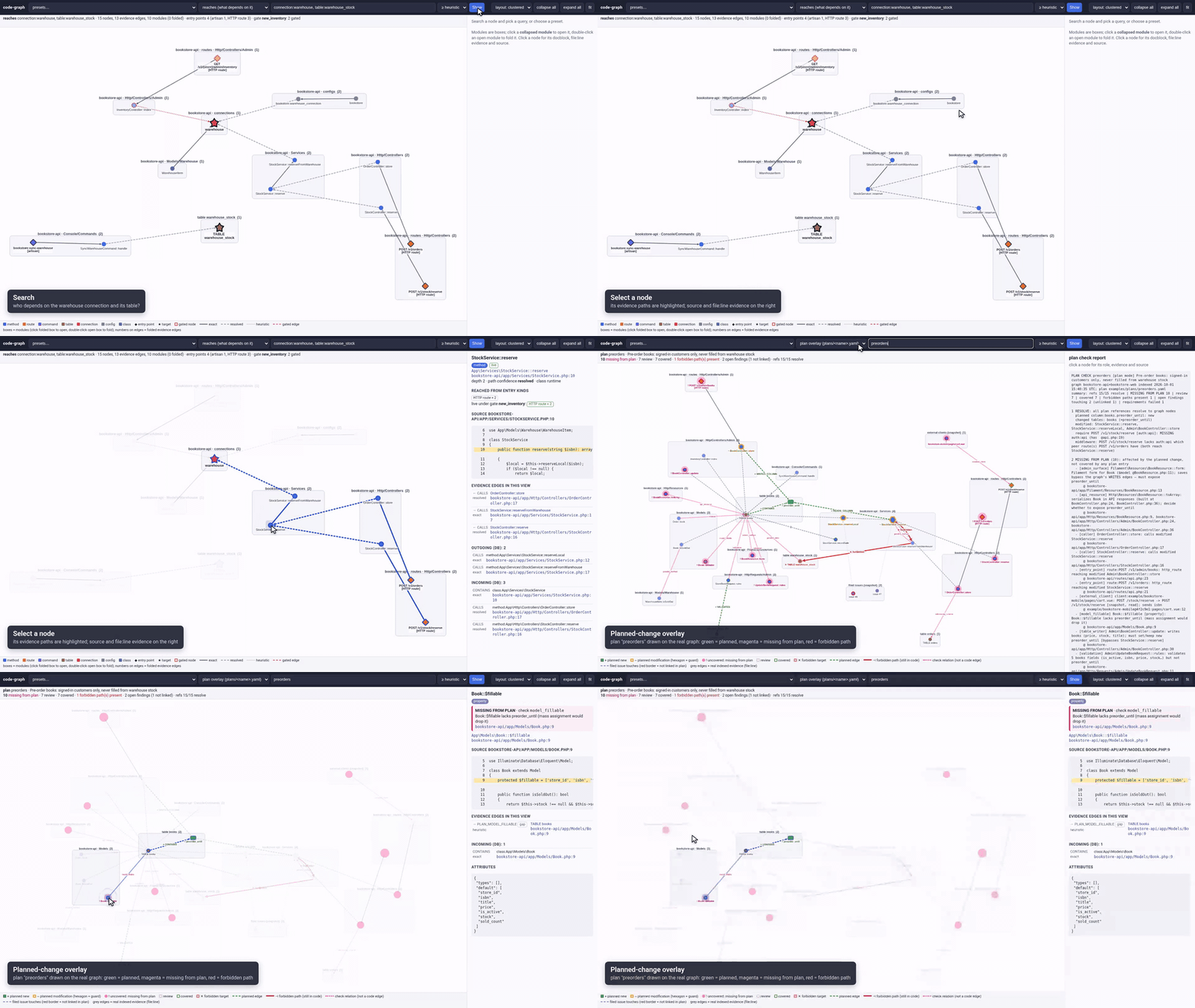
cg serve --db out/graph.db, then open http://127.0.0.1:8177/ .
Next
Python
What .py adds beyond Install, CLI specs, and Graph schema: source roots and module names, reference how values, and FastAPI / Starlette / Flask route ids. The parser is the stdlib ast module. A checkout needs no virtualenv, and the project is never imported. Why a file is unmapped: cg coverage. The python.source_roots key: Configuration.
Graph schema
The graph is one SQLite file. Node and edge details for a language live on that language's page; this page is the index of tables and kinds.